
The Behavioral Interview Roadmap
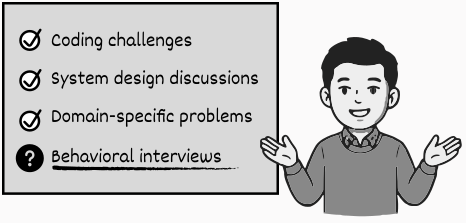
You've read the job description, and you match it almost perfectly. You have the technical skills they need, you've worked on similar problems, and your experience matches what they're looking for. You're confident you can handle the technical parts of the interview: the coding challenges, system design discussions, or domain-specific problems relevant to your role. But technical competence is only part of what companies evaluate. You also have to show them through behavioral interviews that you can deliver results, work effectively with others, and operate at the level they need you to. Even strong experience can be overlooked if you fail to communicate that experience clearly. A poorly delivered story can make you seem unqualified. How? Not because you lack the skills, but because the interviewer never saw them.
The goal of behavioral interview preparation is to perform at your best when it matters. Think of it less like training for a marathon and more like rehearsing for an important presentation. You want to be confident, clear, and authentic. What matters is turning your real experiences into concise, engaging stories and practicing them until they feel natural. The good news is you don’t need months of work, just focused preparation that helps you speak with ease when the time comes. And once you've prepared, future interviews will take much less effort.
Most people approach behavioral interviews the wrong way: backwards. They will wait until the day before the interview before scrambling to remember project details and practice answering questions, while also cramming for the other parts of the interview. They will develop their stories by writing large, dense paragraphs that are difficult to memorize and filled with corporate speak.
The result? Forgetting critical details. Meandering monologues that conceal important contributions. And responses so vague that the interviewers can't assess the candidate’s actual capability. If they're lucky, they’ll get an offer below their true level. If they're not, they’ll get nothing.
This chapter provides a roadmap for behavioral interview preparation and guides you on how to use this book. Whether you have months to prepare or an interview next week, you can adapt the roadmap to your timeline. Once you've built this foundation, you can focus your preparation on the other aspects of the interview process, knowing that your behavioral stories are ready to deliver when needed.
This book is organized into three parts:
Part I: The Framework teaches you how to identify, structure, and deliver behavioral stories. You'll learn what companies evaluate and how to tell your stories well. Part I ends with the essential questions, the ones every company asks and every candidate should prepare for.
Part II: The Competencies cover the specific behaviors that companies typically assess, from problem-solving and delivery to leadership and innovation. Each chapter includes level-appropriate examples and cultural variations.
The book concludes with Nailing the Interview, which covers delivery techniques and how to handle the unexpected, plus an afterword on applying these skills throughout your career.
The Three Pillars of Preparation
To prepare well for behavioral interviews, you will need to work on three main areas:
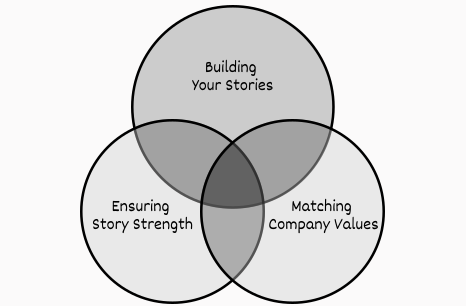
Building Your Stories means taking your raw experiences and turning them into clear stories. How do you identify your best examples, and how do you structure them so that they will be effective?
 Building Your Stories means taking your raw experiences and turning them into clear stories. How do you identify your best examples, and how do you structure them so that they will be effective?
Ensuring Story Strength means crafting your stories to show the right competencies at the appropriate level for your target role. Junior-level stories don't get you senior-level offers, no matter how well you tell them.
 Ensuring Story Strength means crafting your stories to show the right competencies at the appropriate level for your target role. Junior-level stories don't get you senior-level offers, no matter how well you tell them.
Matching Company Values means understanding what your target company cares about and making sure your stories speak to those priorities. A story that impresses a startup might fall flat at an enterprise company.
 Matching Company Values means understanding what your target company cares about and making sure your stories speak to those priorities. A story that impresses a startup might fall flat at an enterprise company.
These elements work together. It’s not enough to have great experiences if you can’t deliver them well. You won’t get the level of job you want if your stories miss their target level. And you can't simply ignore the values of a prospective employer.
To get an offer, all three of your pillars of preparation need to be strong. This roadmap shows you how to develop all three.
How Many Stories Do You Need?
The number of stories in your story bank depends on three factors: the questions everyone faces, your target company's values, and the level you're interviewing for.
Essential Questions (3-4 stories): Every company asks similar general questions. Chapter 4 covers these in detail. You'll always need stories for "Tell me about yourself," "Describe a project you're proud of," and "Why this company/role?" Most companies will also ask you to talk about your weaknesses, failures, or challenges that you’ve faced, so you will need to prepare for these types of questions, too.
Company-Specific Needs (4-10 stories): Different companies value different competencies. Chapters 5 to 13 discuss nine different competencies and how to tell their stories. Senior candidates interviewing at companies with strong cultures may need stories for all of them, whereas entry-level candidates at smaller companies might only have to focus on a few. Therefore, the individual target company will determine which competencies matter most in an interview.
The following is general guidance on the competencies to prioritize for different company types. These are examples to start your research, but note that your specific target company may value different or additional competencies:
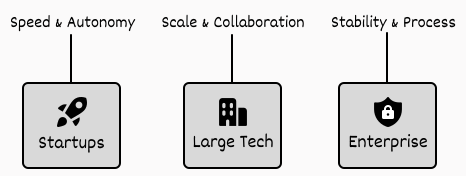
- Startups and high-growth companies emphasize speed and autonomy. At a minimum, focus on Initiative, Delivery, Innovation, and Learning. Research whether they also value Customer Focus or require specific technical knowledge.
- Large tech companies value scale and collaboration. Prepare for Problem Solving, Cross-team Leadership, and Trust and Conflict as core competencies. Many also emphasize Strategic Leadership, Innovation and Developing Others, especially for more senior roles.
- Traditional enterprises value stability and process. Emphasize Delivery, Trust, Customer Focus, and Developing Others as starting points. Some may also value Strategic Leadership for transformation initiatives.
Level Expectations: Your target level influences which competencies become essential and how many you need to cover:
- Entry level (4-6 competencies): Focus on Problem Solving, Delivery, and Learning as your core. Add one or two others that match the company culture, such as Initiative for startups or Customer Focus for product companies.
- Mid-level (5-7 competencies): Build on the entry-level foundation by adding Initiative and Trust and Conflict to show you can work independently and handle team dynamics. Include Customer Focus or Innovation, based on the role you're applying for.
- Senior level and beyond (7-10 competencies): Must show Strategic Leadership and Developing Others to demonstrate organizational impact. Add Innovation to show you can drive technical direction. Include all competencies relevant to your target company's culture and values.
These factors overlap significantly. A single strong story can answer an essential question, cover multiple competencies valued by your target company, and also show the appropriate scope for your level. Build stories that cover all three, then fill any gaps for your specific company.
Mining Your Experiences for Story-Worthy Moments
The best strategy for maximizing coverage is to recognize that major projects, for example, six-month projects, contain multiple stories. Most people approach interview preparation by listing their projects: "I did a database migration, I contributed to a recommendation system, I fixed a production issue." Then they try to force-fit these projects into whatever question gets asked. But this sort of approach leaves value on the table.
Instead, look at each significant project you’ve been involved in. You'll find several moments where you made a real difference. Each of them is its own story.
Consider a half-year database migration project. Instead of thinking "This is my database migration story," identify specific behavioral moments within it. For example:
- Week 2: You discovered the current system would not be able to handle the projected growth, and you had to build a compelling case for migration despite the skepticism of leadership.
- Month 1: Your team split over migration strategy. Half of them wanted a big-bang approach; the other half wanted incremental. You facilitated the decision process.
- Month 3: You invented a novel approach for zero-downtime migration that the company later adopted as standard practice.
- Month 4: Your lead engineer quit suddenly. You restructured the work to ensure the project would still hit the deadline.
- Month 5: You mentored a junior engineer through building a critical component, thus turning a risk into a chance to develop their skills
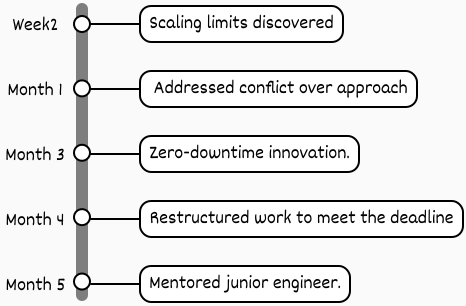
Each of these moments is a complete, standalone story. They're not five versions of "the database migration story"; they're five different stories about Problem Solving, Earning Trust, Innovation, Delivery, and Developing Others that happened during the same project. Some of the contextual details might appear in multiple stories, for example, the technical scope of the migration or the size of the team. But the decisions you highlight will make each story feel different.
Building Your Story Bank
Once you understand that each project contains multiple behavioral moments, you can extract stories from all your experiences. Here's how to build your complete story bank:
-
Start with significant experiences from your recent work: major projects, challenging situations, role transitions, or important initiatives that spanned weeks or months.
-
Identify the story-worthy moments within each experience. Look for times when you:
- Faced a decision that changed the direction of the project
- Solved a problem others couldn't crack
- Influenced a group to agree on the approach to a problem
- Delivered despite a major obstacle
- Learned something that changed how you work
- Stepped up beyond your defined role
-
Use Part II as a reference. It provides detailed examples of what strong behavioral moments look like for each competency. Use these chapters to help identify similar moments in your own experiences.
-
Develop each moment as its own story. Each story covers a single moment. Give brief context about the overall project, then zero in on the specific challenge, decision, or outcome. Chapter 3 (High-Signal Storytelling) shows you how to give a story an effective structure.
This way, you'll pull multiple stories from each major experience. A complex, multi-month project might give you three to four stories. A two-week critical incident might provide just one. However, the number of stories that come out will depend on how many key moments happened, not how long the project took.
Practice Natural Delivery. Your stories should be the start of a conversation, not a memorized monologue. You need to adapt the conversation based on follow-up questions and the interest of the interviewer. Chapter 3 (High Signal Storytelling) covers how to handle common follow-up questions. Chapter 14 (Nailing the Interview) covers delivery techniques and what to do when interviewers interrupt or redirect.
Ensuring Story Strength
Simply having stories isn't enough. They need to match the level you're targeting. A senior engineer who tells entry-level stories won't get far. A data scientist who focuses only on technical implementation will miss the chance to show they can think strategically.
The Four Dimensions
Every story you tell signals four key dimensions to an interviewer:
Scope: The breadth of your work and your specific role within it. Did you improve a single function, own an entire feature, or transform systems across teams? Make the scope of your work clear.
 Scope: The breadth of your work and your specific role within it. Did you improve a single function, own an entire feature, or transform systems across teams? Make the scope of your work clear.
Contribution: What you specifically did, versus what happened around you. Use 'I' to describe your work. Companies want to see the line between what you did and what the team accomplished.
 Contribution: What you specifically did, versus what happened around you. Use 'I' to describe your work. Companies want to see the line between what you did and what the team accomplished.
Impact: The results and value of your work, including your direct influence on outcomes. Can you quantify the improvements? Did you affect team productivity, product metrics, or business outcomes? Provide numbers, and explain how your actions created those results.
 Impact: The results and value of your work, including your direct influence on outcomes. Can you quantify the improvements? Did you affect team productivity, product metrics, or business outcomes? Provide numbers, and explain how your actions created those results.
Difficulty: The complexity of the problems you solved and the decisions you made. Did you follow established patterns or create new approaches? Did you work within clear requirements or work through significant ambiguity? Explain your reasoning and any trade-offs you may have had to make.
 Difficulty: The complexity of the problems you solved and the decisions you made. Did you follow established patterns or create new approaches? Did you work within clear requirements or work through significant ambiguity? Explain your reasoning and any trade-offs you may have had to make.
Chapter 2 (What Companies Are Looking For) explores these dimensions in detail with level-appropriate examples from entry to senior and beyond. The key insight is that recruiters and interviewers use these signals to determine both whether to hire you and at what level.
Your story portfolio should include examples that hit your target level across multiple dimensions. This shows you can work at that level across different situations.
Matching Company Values
You already know which competencies matter for your target company type. But knowing the categories isn't enough, because you need to understand how your specific target company expresses those values and then make sure your stories speak that language.
Research Their Values
Go beyond the career page bullet points. Read employee blogs. Watch tech talks. Study their interview guides. Look for how they describe successful employees and what behaviors get rewarded. When they say "polite relentlessness" or "customer obsession," what does that mean in practice? The competency chapters in Part II include "Cultural Considerations" sections that explain how different company types express these values.
Identify Your Gaps
Map your current stories against their values. If they emphasize "thinking big" but your stories focus on incremental improvements, you have a gap. If they value "learning from failure" but you have only success stories, that's another gap you need to fill.
Fill What's Missing
Sometimes you’ll need to dig deeper for overlooked experiences. Check that side project: there might be an innovation story in it. That production incident: perhaps you could show how you learned from that failure.
Other times, you’ll need to reframe existing stories to highlight different aspects. For example, the same project can emphasize technical depth or customer impact depending on how you tell it.
The goal is to find real examples that show that your values match theirs. Obviously, every company wants to find and hire people who will succeed in their environment. Showing them that your values match theirs will increase your chances of success and, if you accept an offer, your subsequent enjoyment in the role. (And if your values genuinely clash with theirs? Don't fake it. You'd both be better off if you kept looking.)
As a reminder, everything in this book assumes you're telling true stories about real experiences. It can be tempting to embellish or invent, especially when you feel your real stories aren't impressive enough. Resist that urge. The techniques here help you find and present your genuine accomplishments clearly. Fabrications get exposed, and the consequences range from immediate rejection to career-ending termination. It’s simply not worth it.
How To Use This Book
This book is designed for both linear reading and quick reference. Your specific situation and timeline will determine the best approach for you to take.
If you have an interview next week: Focus on Chapter 3 (High-Signal Storytelling) and Chapter 4 (The Essential Questions) first. Chapter 3 teaches the framework you need to structure an effective story. Chapter 4 covers the questions every company asks. Then jump to Part II and skim the competency chapters most relevant to your target role and company. Focus on the example stories at your level, rather than reading every section. Finally, review Chapter 14 (Nailing the Interview) for tips on delivery. You won't have time for everything, but you can still build a solid foundation.
If you're actively interviewing with multiple companies: Work through Part I sequentially to understand the full preparation framework. Then use Part II as a reference, reading the relevant competency chapters based on what each company values. Keep notes on which stories work best for different company types. Chapter 14 (Nailing the Interview) covers delivery and how to handle unexpected situations, and the Afterword offers perspective on using these skills beyond interviews.
If you're planning ahead: Read the book straight through to understand the complete system. Part I gives you the framework and roadmap. Part II helps you understand what excellence looks like for each competency at different levels. Chapter 14 (Nailing the Interview) shows you how everything comes together and provides techniques for peak performance. Take time to complete all three pillars of preparation, and build a comprehensive story bank you can adapt for any opportunity.
If you're assessing your readiness: Start with Chapter 2 (What Companies Are Looking For) to understand how companies evaluate level and fit. Then sample stories from Part II at your target level. Can you tell similar stories with comparable scope and impact? If not, you'll know where to focus your preparation.
Your experiences contain powerful stories, and preparing them isn't just about landing offers. This book will help you find those stories, develop them, and tell them in a way that shows what you're capable of.